
What Do Cloud Service Providers Need to Know About Indiana RAMP?
Indiana has established a statewide Risk and Authorization Management Program (RAMP) to create more...

As state governments continue to look for ways to evaluate the security of cloud services, GovRAMP is consistently becoming part of the conversation.
But when a state is described as having “adopted” GovRAMP, that doesn't always mean the same thing.
For providers looking to sell to state governments, understanding these differences is important.
Instead of viewing GovRAMP adoption as a simple yes-or-no question, it can be helpful to look at how each state uses GovRAMP and what that means for providers pursing opportunities there.
GovRAMP adoption can look different from one state to another.
A state may recognize GovRAMP without requiring it. Another may accept GovRAMP as a way to demonstrate that a provider meets its security expectations. A different state may make GovRAMP verification a requirement for certain government contracts.
GovRAMP’s Adoption Binder describes several adoption approaches, including Require, Hybrid, Prefer, and Accept based on a government's governance structure, maturity risk, and implementation needs.
For the purposes of this guide, RAMPQuest uses the following profiles to organize the different ways states may interact or with or use GovRAMP:
Acknowledge → Participate in Continuous Monitoring → Accept → Prefer → Require
There is also another approach to consider: some states have their own security programs and may use GovRAMP as a way for providers to meet those state requirements.
The goal of these categories isn't to replace GovRAMP's adoption approaches. Instead, they're intended to provide a practical way to understand the state landscape.
Understanding these categories can help providers get a clearer picture of what GovRAMP adoption actually means in each state.
A state that acknowledges GovRAMP recognizes it as a way for a provider to demonstrate its security practices.
However, GovRAMP has not yet become part of the state's formal process.
What this means for Providers: GovRAMP may be useful when demonstrating your security practices to the state, but it isn't a formal requirement.
Some states participate in GovRAMP's Continuous Monitoring program. This allows them to access ongoing information about the security of participating providers.
What this means for Providers: The state is actively engaging with GovRAMP's ongoing continuous monitoring program, but that does not necessarily mean every provider doing business in the state must have GovRAMP verification.
A state that accepts GovRAMP allows providers to use GovRAMP as a way to demonstrate that they meet the state's security expectations.
However, having GovRAMP verification is not required.
What this means for Providers: GovRAMP can provide a way to demonstrate your security practices, but you may still have other options for meeting the state's requirements.
A state that prefers GovRAMP gives an advantage to those that have it, but doesn't make it a requirement.
What this means for Providers: GovRAMP may help your organization stand out when pursuing opportunities, but not having it doesn't prevent you from doing business with the state.
A state that requires GovRAMP, or another specifically approved security standard, makes it part of the requirements for certain contracts or situations.
What this means for Providers: If you want to pursue those opportunities, meeting the state's security requirements is necessary before you can do business.
Some states have created their own security programs instead of requiring GovRAMP directly.
In these cases, GovRAMP may provide a path for a provider to meet the state's requirements through that state program.
Texas is an example of this. Texas has its own TX-RAMP program, so it should not simply be described as a state that requires GovRAMP. Instead, GovRAMP may serve as a recognized path into the state's own program.
These categories may sound similar, but they can mean very different things for a provider.
For example, a state that accepts GovRAMP may allow a provider to use its GovRAMP verification to demonstrate its security practices without requiring the provider to have it.
A state that requires GovRAMP is different. In that case, achieving the appropriate verification is necessary for a provider to pursue certain contracts.
That's why it isn't enough to ask:
“Does this state use GovRAMP?”
A better question is:
“How does this state use GovRAMP, and what does that mean for my organization?”
It’s also important to look past whether GovRAMP is recognized or required and understand what the procurement actually requires. A solicitation may specify a particular GovRAMP status or Public Control Baseline, along with a deadline for achieving it. Some procurements may also allow a provider to use a defined transition period while working toward the required status.
For providers, that means state adoption is only the starting point. The next step is understanding the specific security, status, and timing requirements attached to the opportunity you want to pursue.
Based on RAMPQuest's research as of September 2026, states fall across several different points on the adoption profile.
Applicable States: Michigan
Michigan recognizes GovRAMP as a way to provide third-party security evidence but has not yet built it into a formal statewide process.
Applicable States: Alabama, Alaska, California, Idaho (Courts), Kansas, Maine*, Missouri, Nebraska, and New Jersey
These states recognize GovRAMP and participate in or have access to GovRAMP's Continuous Monitoring program.
Maine requires additional consideration because it also has requirements that place it in the Require category under certain circumstances.
Applicable States: Colorado, Connecticut, Massachusetts, North Dakota, Ohio, Oklahoma, Oregon*, Vermont, and West Virginia
These states accept GovRAMP as a way to demonstrate security, but GovRAMP itself is not required.
The source information specifically notes that Oregon's participation reflects agency-level activity and should not automatically be interpreted as a statewide requirement.
Applicable States: New Hampshire
GovRAMP is preferred, meaning not having GovRAMP may affect competitiveness but does not determine eligibility.
Applicable States: Arizona, Georgia, Indiana, Minnesota, Nevada, North Carolina, Utah, and Maine under certain conditions
These states have situations where GovRAMP or an approved alternative can become a requirement for doing business with the state.
Nevada's classification should be confirmed against the current state source before being treated as final.
Applicable States: Texas
Rather than requiring GovRAMP itself, Texas has its own TX-RAMP program. GovRAMP may provide a recognized path into TX-RAMP, making Texas an example of why a simple “GovRAMP required: yes or no” classification can be misleading.
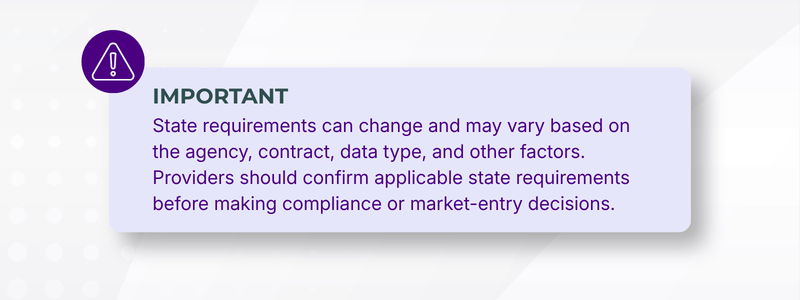
The state adoption profiles provide a useful way to look at the growing number of state opportunities without treating every state the same.
The profiles can help answer questions such as:
Where could GovRAMP help demonstrate our security practices?
Where might GovRAMP give us a competitive advantage?
Which states may require GovRAMP or an approved alternative?
Which states have their own programs?
Which states should we pay closer attention to as we plan our market strategy?
It also highlights an important point: a state recognizing GovRAMP is not the same as a state requiring GovRAMP.
That distinction can make a difference when deciding where to invest time and resources.
For those that want to sell in multiple states, this landscape can also serve as a starting point for comparing their target markets. Rather than looking at each state in isolation, providers can begin by identifying where their target states fall and then look more closely at what each state expects.
If your organization plans to sell to more than one state, understanding the adoption profiles is a good place to start.
Begin by identifying the states where you want to do business. Then, look at how each state approaches GovRAMP.
From there, you can begin asking:
Your strategy should start with your business goals.
Identify the states where you currently want to sell, as well as states that may become important markets in the future.
Knowing whether a state acknowledges, accepts, prefers, or requires GovRAMP can help you understand how important GovRAMP may be to your plans.
Also look at whether the state participates in Continuous Monitoring or operates its own security program that may recognize GovRAMP.
Once you know where your target states stand, you can start looking for areas where their security expectations overlap.
This can help you understand whether one investment in your security program could support opportunities in multiple states.
Finally, look at where your target states take different approaches.
Some states may have additional requirements, different timelines, or their own security programs. Understanding those differences can help you identify what needs additional attention as you plan your path forward.
The goal is not to assume that one approach will work for every state. Instead, it is to understand where your efforts may overlap and where you may need to take a different approach.
GovRAMP adoption is continuing to grow, but states are not all adopting the program in the same way.
Some recognize GovRAMP. Some accept it. Some prefer it. Others require it for certain opportunities. And some states have their own programs that may use GovRAMP as a path toward meeting their requirements.
Understanding these differences is the first step toward making informed decisions about where to pursue state government opportunities.
RAMPQuest can help you take that next step by looking at the states you want to sell in and helping you understand how their requirements may fit together.
Tell us which states you're targeting, and we'll help you start mapping out your path.
