
We provide cybersecurity consulting solutions to help protect organizations from cyber threats.

If you're pursuing GovRAMP, you're taking an important step toward winning government contracts and demonstrating your commitment to cybersecurity. But as you begin exploring the process, you'll likely encounter new terminology, requirements, and decisions that can make the path forward feel unclear.
Two terms that commonly cause confusion are Readiness Assessment Report (RAR) and Security Assessment Report (SAR).
While both assessments play an important role in your GovRAMP journey, they serve different purposes. Understanding the difference can help you determine where you are in the process, prepare more effectively, and avoid investing valuable time and resources in the wrong areas.
What Is a 3PAO and What Do They Do?
Before understanding the difference between a Readiness Assessment Report (RAR) and a Security Assessment Report (SAR), it's important to understand the role of a Third-Party Assessment Organization (3PAO).
A 3PAO is an independent organization authorized to assess whether your cloud environment meets GovRAMP security requirements. During an assessment, the 3PAO reviews your security documentation, interviews key personnel, examines technical evidence, and tests security controls to determine whether they've been implemented effectively.
Depending on where you are in your GovRAMP journey, the outcome of that assessment is either a Readiness Assessment Report (RAR) or a Security Assessment Report (SAR). Once completed, the report is submitted to the GovRAMP PMO for review as part of the applicable approval process.
While organizations like RAMPQuest help clients prepare for these assessments by identifying security gaps, strengthening documentation, and developing a compliance strategy, the formal assessment itself is always performed independently by a 3PAO.
What Is a Readiness Assessment Report?
A Readiness Assessment Report (RAR) is the result of a readiness assessment performed by a 3PAO. Its purpose is to help determine whether you're prepared to move forward with your GovRAMP journey.
Instead of providing a full validation of every applicable security control, a RAR evaluates your current security posture and identifies areas that may need additional attention before you pursue authorization.
The purpose of a readiness assessment is to provide clarity. It helps you understand what you've already put in place, where gaps exist, and what steps you should take to strengthen your security program before moving forward.
If you're pursuing GovRAMP Ready status, the RAR demonstrates that you've established the foundational security capabilities needed to continue moving through the program.
Once the assessment is complete, the 3PAO submits the RAR to the GovRAMP PMO for review. As the GovRAMP PMO, RAMPQuest then reviews the assessment package to determine whether the requirements for GovRAMP Ready have been met before the status is awarded.
What Is a Security Assessment Report?
Unlike a readiness assessment, which focuses on preparedness, a Security Assessment Report (SAR) evaluates whether you've effectively implemented the applicable security requirements.
It includes a detailed review of your documentation, control implementation, testing results, and any findings identified during the assessment.
If you're pursuing GovRAMP Authorized status, the SAR documents the results of the 3PAO's assessment and demonstrates how your security controls were evaluated against GovRAMP requirements.
Once the assessment is complete, the SAR is submitted to the GovRAMP PMO for review. RAMPQuest reviews the assessment package to determine whether the requirements for GovRAMP Authorized have been met before the status is awarded.
RAR vs. SAR: Understanding the Difference
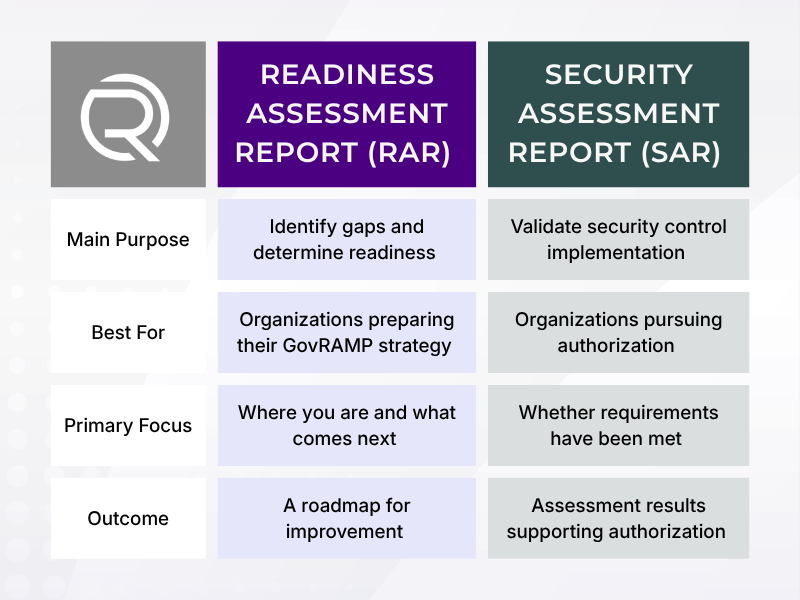
At a high level, the difference comes down to readiness versus validation.
A RAR helps answer:
"Are we ready to pursue GovRAMP?"
A SAR helps answer:
"Have we implemented and validated the required security controls?"
Both assessments provide value, but they support different stages of your compliance journey.
Why the Difference Between a RAR and SAR Matters
The assessment you pursue should depend on the maturity of your security program and your readiness to demonstrate compliance.
Selecting the wrong starting point can create unnecessary delays, additional rework, and increased costs. Organizations that engage a 3PAO before understanding their gaps may discover issues that require significant time and resources to address during the assessment process.
So, before moving forward with a formal assessment, it's important to establish a clear understanding of your current security posture, identify gaps, and create a roadmap for improvement.
For organizations still building their compliance program, a readiness review such as RAMPQuest's Progressing Security Snapshot can provide the visibility needed to prioritize next steps and prepare for a successful GovRAMP assessment.
Preparing for the Right Assessment
One of the biggest mistakes you can make is treating GovRAMP as a single milestone rather than an ongoing process.
A successful compliance strategy starts with understanding your current security maturity, identifying gaps, and building a realistic roadmap. Depending on where you are in your journey, that may mean starting with a readiness assessment to establish a clear path forward. If you've already built a mature security program, it may mean preparing for a full security assessment instead.
The key is making sure your assessment aligns with your current capabilities and your long-term goals.
What to Expect During a 3PAO Assessment
Whether you're pursuing GovRAMP Ready or GovRAMP Authorized, working with a 3PAO involves more than just submitting documentation. Throughout the assessment, you can generally expect the 3PAO to:
- Review your security documentation and supporting evidence.
- Interview key personnel responsible for your security program.
- Evaluate how your security controls have been implemented.
- Test applicable controls to verify they are operating as intended.
- Document findings, observations, and any remediation items.
Preparing your documentation, evidence, and internal teams ahead of the assessment can help the engagement run more efficiently and reduce delays during the GovRAMP review process.
How RAMPQuest Helps You Navigate GovRAMP
Navigating GovRAMP requirements can be complex, especially when you're balancing compliance initiatives with the day-to-day priorities of running your business.
As a founding GovRAMP PMO, RAMPQuest brings firsthand knowledge of the program's expectations and review process. We help organizations prepare for successful 3PAO assessments by identifying security gaps, strengthening documentation, and building a practical strategy for achieving GovRAMP verification.
If you're preparing for your first assessment or navigating the official review, we’re here to guide you through the process.
