
How to Determine the Right CMMC Level for Your Defense Contract
If your organization works with the Department of War (DoW), understanding your cybersecurity...

If your organization is pursuing GovRAMP, exploring FedRAMP, responding to government security requirements, or selling technology solutions to public-sector customers, you’ve likely encountered NIST SP 800-53 Rev. 5.
Maybe it appeared in a customer questionnaire. Maybe it appeared during a readiness assessment. Or perhaps you’re trying to understand the requirements behind a government cybersecurity program.
Whatever brought you here, there's a good chance you're trying to answer a fairly simple question:
What exactly is NIST SP 800-53 Rev. 5, and why does it matter?
NIST SP 800-53 Rev. 5 is a catalog of security and privacy controls published by the National Institute of Standards and Technology (NIST). It provides organizations with a structured approach to managing cybersecurity risk and protecting sensitive information.
More importantly, it serves as the foundation for many government cybersecurity programs, including GovRAMP and FedRAMP.
One of the most common points of confusion is the difference between NIST and NIST SP 800-53 Rev. 5.
NIST (National Institute of Standards and Technology) is a federal agency that develops standards, guidance, and best practices across a variety of industries, including cybersecurity.
NIST SP 800-53 Rev. 5 is one of the cybersecurity publications NIST maintains. It provides a catalog of security and privacy controls that organizations can use to protect systems, data, and operations from cyber threats.
Think of it this way:
When people refer to "NIST 800-53 Rev. 5 compliance," they're typically referring to implementing and maintaining controls that align with the framework’s requirements.
Federal agencies needed a consistent way to protect sensitive systems and information.
Without a common framework, each agency could end up defining security requirements differently, which would then create confusion, inconsistency, and unnecessary risk.
NIST SP 800-53 Rev. 5 was developed to establish a common set of security and privacy controls that organizations could use to identify, manage, and reduce cybersecurity risk.
Over time, the framework evolved beyond federal agencies and become one of the most widely referenced cybersecurity frameworks in the public sector.
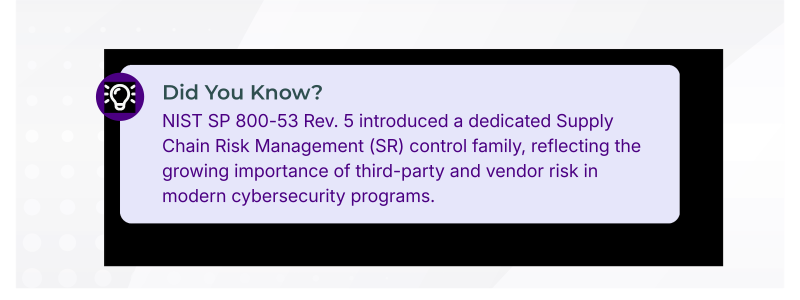
Today, NIST SP 800-53 Rev. 5 includes more than 1,000 security and privacy controls organized across 20 control families covering areas such as:
For many organizations, NIST SP 800-53 Rev. 5 isn't just a cybersecurity framework. It's a business requirement.
Government agencies, procurement teams, and security reviewers increasingly expect organizations to demonstrate a structured approach to cybersecurity.
Rather than focusing on individual tools or technologies, NIST SP 800-53 Rev. 5 helps organizations build repeatable processes for managing risk, protecting data, responding to incidents, and maintaining security over time.
Rather than focusing on individual security tools or technologies, the framework helps organizations build repeatable processes for managing risk, protecting data, responding to incidents, and maintaining security over time.
The framework provides a common language that organizations, assessors, and government stakeholders can use to evaluate cybersecurity maturity and security practices.
Imagine you're a software company hoping to sell your solution to government agencies.
Your product may be innovative. Your team may be highly qualified. Your pricing may be competitive.
But before an agency purchases your solution, they need confidence that their data will be protected.
Rather than evaluating every provider differently, many government programs rely on frameworks built upon NIST SP 800-53 Rev. 5 to establish consistent security expectations.
This creates a common language between organizations, assessors, and government stakeholders, making it easier to evaluate risk and build trust.
NIST SP 800-53 Rev. 5 was originally developed to support federal information systems and remains a foundational cybersecurity framework across federal agencies.
Organizations supporting government agencies frequently encounter customer requirements rooted in NIST guidance, even when they are not directly pursuing GovRAMP or FedRAMP.
FedRAMP uses NIST SP 800-53 Rev. 5 as the basis for evaluating cloud service providers seeking authorization to work with federal agencies.
Organizations pursuing FedRAMP will spend significant time implementing and documenting controls derived from the framework.
GovRAMP leverages NIST SP 800-53 Rev. 5 to help state and local governments assess the security of cloud solutions.
As GovRAMP's founding Program Management Office (PMO), we've worked with many organizations that first encountered NIST SP 800-53 Rev. 5 while exploring opportunities in the public sector.
In many cases, understanding the framework helps organizations better understand what government buyers are looking for and why certain security requirements exist in the first place.
Not every organization using NIST SP 800-53 Rev. 5 works with the government.
Many private-sector companies voluntarily adopt parts of the framework to strengthen their cybersecurity programs, improve risk management, and demonstrate security maturity to customers and partners.
One reason NIST SP 800-53 Rev. 5 is so widely referenced is because it serves as the foundation for several well-known government cybersecurity programs.
For example:
While each program has its own processes and requirements, they are all built on the same core security principles established by NIST.
Through our work as GovRAMP's founding Program Management Office (PMO), at RAMPQuest, we've helped many organizations make sense of complex cybersecurity requirements. What we've learned is that understanding the foundation behind the requirements often makes the entire process feel far less overwhelming.
Not necessarily.
The better question is:
Do your customers, partners, regulators, or government stakeholders expect you to demonstrate a mature cybersecurity program?
If you work with government entities, provide cloud services, handle sensitive information, or anticipate future compliance requirements, NIST SP 800-53 Rev. 5 is worth understanding.
Even if you’re not required to implement every control, the framework provides valuable guidance for building a stronger security program.
It's easy to think of NIST SP 800-53 Rev. 5 as a long list of security controls.
However, it's something much more important.
At its core, NIST SP 800-53 Rev. 5 is a framework for building trust.
It helps organizations protect sensitive information, manage cybersecurity risk, and demonstrate that security is being approached in a thoughtful and consistent way.
If NIST SP 800-53 Rev. 5 seemed intimidating before you started reading this article, hopefully it feels a little more approachable now.
Behind all the acronyms and technical language is a fairly simple idea: helping organizations build security practices they can rely on.
That's why so many government cybersecurity programs continue to use it as their foundation.
Have questions? Click the link below to talk with RAMPQuest.
