
How to Determine the Right CMMC Level for Your Defense Contract
If your organization works with the Department of War (DoW), understanding your cybersecurity...

The National Institute of Standards and Technology Special Publication (NIST SP) 800-53 launched Revision 5 (Rev. 5) in 2020. Since then, organizations like FedRAMP and GovRAMP have been working toward implementing the new security standard. Rev. 5 introduces tailored considerations for cloud environments, addresses unique supply-chain risks, and incorporates advancements in technology. To best align with today’s modern threat landscape, NIST has changed control requirements through control text, updated parameters, and control discussion criteria. In addition, approximately 90 controls were withdrawn and incorporated into other control requirements or implementation language, making them easier to comprehend. Rev. 5 also holistically combines privacy requirements with security controls, putting the two on equal footing and ensuring that privacy and security are closely aligned. This is especially important given the frequency with which organizations handle sensitive personal data.
One of the biggest introductions in Rev. 5 is the Supply Chain Risk Management (SCRM) control family, which includes new, critical control requirements. These new requirements streamline supply-chain controls, enhance processes for supplier assessments and reviews, and foster more-efficient supply-chain management. SCRM aspects safeguard critical system components and business offerings within complex infrastructures. These controls ensure security and privacy requirements are addressed accordingly.
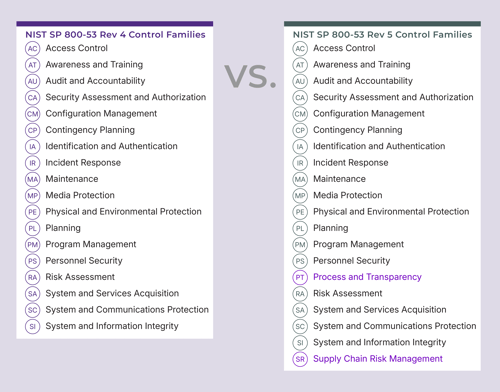
The SR-2 control requirement, which involves building out the SCRM plan, can pose a steep learning curve for many providers, especially those new to working in the cloud space. A successful transition requires implementing robust checks and balances within the supply chain and instituting efficient documentation of processes. Referring to NIST guidelines for SCRM and utilizing available templates can greatly assist providers navigating this area, especially in light of the new control language. Rev. 5 also focuses more on requirements for third-party hardware, software, and services to keep malicious elements out of the supply chain. GovRAMP has also updated its requirements to align with Rev. 5 and has provided templates as a reference.
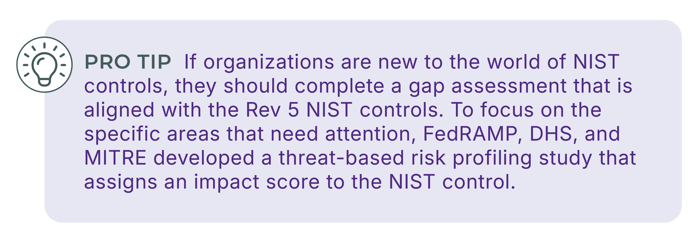
All providers should conduct a gap assessment to allocate resources effectively, including discovering the current security posture of the company and how to improve it. When implementing new control requirements, providers should follow MITRE impact scoring. This model shows which control requirements will have the largest impact on the provider’s security posture. Upon completion, the gap assessment will show which controls are already in place and which need work.
Companies that currently follow the NIST 800-53 framework need to update to Rev. 5. Although not a minor update, Rev. 5 builds on the foundation established in Rev. 4. Therefore, the work completed for the Rev. 4 transition is still necessary, and puts companies a step closer to adopting Rev. 5. Rev. 5 also reduces the level of redundancy in its controls, making adoption more natural, easier to understand, and less time-consuming.
As of Oct. 1, 2024, providers in the process of obtaining GovRAMP certification can continue to utilize Rev. 4 documentation, but must adhere to Rev. 5 documentation for certification.
Implementing the new control requirements may seem daunting, but with the right guidance, it is a straightforward process. An initial step is conducting research and collaborating with the development team to explore available libraries. By gaining a Software Bill of Materials (SBOM), companies gain clarity on what is incorporated in the software builds, allowing them to stay ahead.
Along with the updates, Rev. 5 changes the hardening program for servers, such as the infrastructure components, to the Defense Information Systems Agency (DISA) Security Technical Information Guides (STIGs) from the Center for Internet Security benchmarks. By engaging with IT leaders, companies can ensure the STIGs are properly implemented. The sooner information security gets involved, the smoother the Rev. 5 transition will be. Rev. 5 increases the accountability of senior leaders in implementing the new controls. This allows for an open dialogue between the development and IT staff, ensuring all stakeholders are on the same page.
Companies navigating the transition to NIST 800-53 Rev. 5 from Rev. 4 could greatly benefit from industry leaders who are familiar with this process. LinkedIn offers an excellent opportunity to connect with industry leaders through various groups and networks, which are valuable resources for understanding the best transition tools and practices. Industry leaders understand how licensing costs and software can add up quickly, and how certain decisions affect companies in the long term. Gaining this critical insight benefits companies from a security-risk and financial perspective and prevents long-term resource constraints.
“I cannot stress enough the importance of community to enable Rev. 5. These [LinkedIn] communities are very valuable in driving innovation and compliance within all organizations. When security practitioners work together, whether we are competitors or in different industries, it helps make everyone more secure.” – Noah Brown, Chief Information Security Officer at RAMPQuest
With a transition this significant, some things can fall through the cracks. When providers conduct an internal assessment, they may not be aware of some control findings related to a specific control. Although there may be pressure from leadership to implement solutions quickly, providers may not fully understand the controls being implemented as well as someone who works in the advisory or assessment space does. This can lead to missing necessary processes. A critical obstacle for larger organizations is the alignment of priority for all stakeholders. The larger the organization, the harder it will be to implement new requirements and control that risk.
To provide companies with further clarity in this transition, NIST has published significant specific control guidance.
The two most common causes of breaches are phishing and unpatched software. Together, these often result in a breach for any size organization. Implementing security awareness training at all levels is critical. Employees should be trained on the differences between a phishing attempt and spam, as well as how to handle a phishing attempt properly when identifying one. Education and training for stakeholders and leadership are crucial. Executives need to have buy-in on this transition and understand what is at stake if training is not properly enforced. To execute employee awareness training successfully, the training needs to be continuous and kept at the forefront of every employee’s mind.
Many larger breaches stem from third-party systems that have access to an organization’s environment. Partnering with a third party that does not meet all compliance requirements sounds cost-effective, but larger issues could develop for the organization. Companies must prioritize education on what a third-party partnership could mean for the organization financially. Organizations that already have third-party partnerships must validate that the suppliers meet the same security standards as the company’s own products or services. Validating this will strengthen the risk and cyber posture of an organization, while driving the adoption of Rev. 5 in its entirety.
“Implementing NIST SP 800-53 Rev. 5 controls can feel like a heavy lift, but with the right guidance, it becomes a clear and manageable process. The key is turning requirements into practical, repeatable actions that strengthen your security posture over time.
At RAMPQuest, we help you move from understanding the controls to confidently putting them into place, so you can build momentum, stay aligned, and move forward with confidence.”
