
Navigating NIST 800-53: A Deep Dive into Compliance
With the current standing of cybersecurity, threats of data breaches are a constant and costly...

For defense prime and sub-contractors handling Controlled Unclassified Information (CUI), meeting security requirements takes continued attention and maintenance.
That’s easier said than done.
Systems change. Employees come and go. New vendors get added. Policies get updated. And the documentation that accurately described an environment six months ago may not tell the whole story today.
Ongoing NIST SP 800-171 support helps defense contractors maintain their security practices, documentation, and assessment readiness as their environment and requirements change. It includes recurring security reviews, documentation, evidence maintenance, remediation planning, change impact analysis, and access to compliance expertise.
A one-time assessment tells an organization where it stands at a particular point in time. Consistent support helps the organization stay aligned after that snapshot.
Ongoing NIST SP 800-171 support helps defense contractors maintain their security practices and documentation needed to protect CUI and meet applicable requirements over time, including DFARS Clause 252.204-7012 “Safeguarding Covered Defense Information and Cyber Incident Reporting.”
The important word here is ongoing.
That means regular reviews of your security program, updating documentation, addressing new gaps caused by vulnerabilities and risk, and having access to compliance expertise when questions come up.
In other words, compliance becomes part of the organization's routine rather than something that suddenly becomes urgent when an assessment is on the calendar. Or worse, after a cyber incident.
Continued support includes security reviews, documentation maintenance, remediation assistance, change impact analysis, and advisory services that help contractors keep their security program aligned with the applicable requirements.
The exact work will vary by need, but several areas tend to overlap in importance.
Regular security reviews help contractors identify issues before they become assessment surprises.
These reviews do not necessarily mean repeating a full assessment every few months. Instead, they provide a recurring check on whether security practices operate as intended and whether internal or external changes to the environment have created new gaps.
A review may include:
Reviewing the implementation of applicable security requirements
Identifying new or recurring gaps
Verify whether remediated requirements operate correctly
Reviewing changes to systems, processes, personnel, and supply chain
Evaluating whether new business or technology changes affect compliance
Preparing evidence before it becomes a last-minute scramble
The goal is simple: find problems while there is still time to do something about them.
A security program is only part of the equation. Contractors also need documentation that explains how those practices are implemented and evidence that can demonstrate they are working.
This is one of the areas where security programs quickly fall behind.
Maybe a system has changed. A responsibility moved from one employee to another. A new technology was introduced. A process was updated, but the related documentation never caught up.
Lasting support can help keep items such as policies, procedures, system security plans (SSP), and supporting evidence aligned with the environment they are meant to describe.
That matters because an outdated SSP questions your security program even when the underlying security practice is sound.
Finding a gap is useful. Knowing what to do about it is even better.
Ongoing compliance consulting helps organizations prioritize remediation efforts based on risk, requirements, and the resources available.
Rather than treating every finding as equally urgent, contractors work through issues in a repeatable process:
Identify → prioritize → remediate → document → review.
That creates a repeatable process for improving the security program rather than relying on a chaotic sprint before an assessment.
Changes to the business can create changes to the security program.
A new cloud service may affect how CUI is stored or transmitted. A new vendor may introduce additional risk. A change in remote access affects existing security practices. A new employee may take over a security responsibility that was previously assigned to someone else.
Continued cybersecurity compliance support can help contractors evaluate those changes before they create larger problems.
That may include reviewing:
New systems or cloud services
Changes to CUI flows or system boundaries
New or changed vendors
Changes to access or authentication processes
New technology or security tools
Changes to personnel responsibilities
Business process changes that affect the CUI environment
The goal is to understand the security impact of a change before it becomes a documentation or assessment problem.
Sometimes the hardest compliance questions come from changes that do not look related to compliance at all.
Should a new cloud service be added to the environment? Does a change in how employees access systems affect existing security policy? Does a new vendor introduce supply chain risk? What documentation needs to prove that?
Having access to experienced advisors gives contractors a resource for working through those decisions before they create unnecessary risks or rework.
The biggest benefit of outstanding support is keeping the security program current between formal assessments.
Without that attention, it is easy for a contractor to complete remediation, update its documentation, and then slowly drift out of alignment as the business changes.
New technology is deployed. A process changes. A vendor is added. Security responsibilities shift. Months later, the organization starts preparing for an assessment and discovers that its documentation no longer matches the environment.
Now the organization has two problems instead of one: the underlying gap and the time pressure to fix it.
Ongoing NIST SP 800-171 compliance support helps prevent that cycle by keeping compliance work moving throughout the year.
Ongoing support also keeps CUI protection connected to the organization's day-to-day security program.
NIST SP 800-171 provides security requirements for protecting the confidentiality of CUI in nonfederal systems and organizations that process, store, or transmit that information.
The goal is not simply to maintain an assessment package. It is to maintain the security practices and documentation that support CUI protection as the organization changes.
Ongoing support helps defense contractors maintain the requirements that apply today while preparing for changes that affect them in the future.
That distinction is especially important with NIST SP 800-171 Rev. 3.
NIST finalized Rev. 3 on May 14, 2024, making it the current version of the NIST publication for protecting CUI in nonfederal systems and organizations. Rev. 2 was withdrawn the same day that Rev. 3 was finalized.
However, current CMMC Level 2 requirements continue to use NIST SP 800-171 Rev. 2. The DoW has stated that Rev. 3 will be incorporated into CMMC through future rulemaking.
For contractors, that means Rev. 3 is something to understand and plan for, but it does not replace the Rev 2 requirements that currently apply to their CMMC obligations.
Rev. 3 is more than a new version number. It reorganizes and adds specificity to the requirements while introducing organization-defined parameters (ODPs) that force organizations to establish certain values, frequencies, thresholds, or other parameters for their environments.
For contractors, that means more decisions to make and more details to document.
A contractor preparing for Rev. 3 may need to consider questions such as:
Which current security practices still satisfy the updated requirements?
Where do gaps exist between Rev. 2 and Rev. 3?
Which ODPs apply to the organization's environment?
What policies, procedures, and evidence need to be updated?
Are current systems and processes designed to support the new requirements?
How will the changes affect the organization's CUI environment and assessment scope?
Rev. 3 also puts greater emphasis on areas such as assessment, planning, risk management, authorization and monitoring, and supply chain risk management.
In other words, preparing for Rev. 3 is not something you can solve by swapping one checklist for another.
It requires understanding how the changes affect the organization's actual security program.
Contractors should continue meeting the requirements that apply to them today while building an informed plan for Rev. 3.
That does not necessarily mean rebuilding the entire security program immediately.
A practical starting point is to:
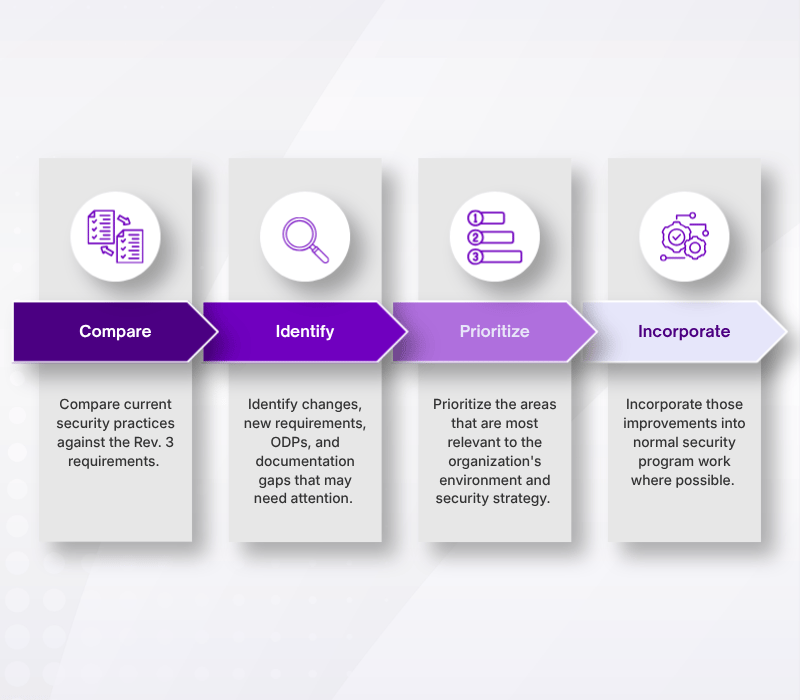
For example, if an organization is already updating policies, reviewing access controls, improving monitoring, or evaluating third-party risks, those efforts can be considered through a Rev. 3 lens rather than treated as completely separate work.
That approach allows contractors to prepare for future requirements without losing focus on the requirements that apply today.
A transition between revisions is exactly the kind of situation where a one-time assessment can fall short.
An assessment can tell a contractor where it stands today. Ongoing support helps the organization keep moving as requirements, technology, and business operations change.
That can include:
Reviewing changes to requirements
Helping interpret how they affect the organization's environment
Updating documentation
Identifying gaps between revisions
Prioritizing remediation work
It also means contractors do not have to choose between preparing for the future and maintaining today's requirements.
They can do both.
And that is one of the biggest advantages of ongoing compliance consulting. Contractors have trusted advisors they can turn to as requirements evolve, rather than having to figure out every change on their own or wait until the next assessment to discover that their security program needs to catch up.
RAMPQuest helps defense contractors understand what applies to their environment, identify security and documentation gaps, prioritize remediation, and maintain readiness as their organization changes.
That support can include:
Continual security reviews
Documentation and evidence maintenance
Change impact analysis
Remediation planning
Access to experienced compliance advisors
With requirements evolving, having a trusted advisor can help organizations make sense of what has changed, determine what needs attention, and keep moving toward readiness instead of starting over each time the requirements change.
