
What is Ongoing NIST SP 800-171 Support?
For defense prime and sub-contractors handling Controlled Unclassified Information (CUI), meeting...

For many small and growing businesses, cybersecurity compliance becomes a priority because something changes. A new contract includes security requirements. A government opportunity requires a formal security program. Or a cyber incident affects the business, prompting leadership to take a closer look at existing security practices.
The challenge is that smaller organizations often don’t have a dedicated compliance team. Security responsibilities may already be spread across IT, security, operations, or leadership. Adding compliance work to those responsibilities can quickly become a significant task, especially when internal teams have limited compliance expertise.
This guide covers where growing businesses commonly need support with cybersecurity compliance requirements and how to approach compliance without unnecessary cost or complexity.
Cybersecurity compliance can help small businesses identify and reduce risk, protect customer relationships, and establish security practices that support long-term growth.
The financial impact of a security incident can extend well beyond the cost of recovering affected systems. Downtime, lost productivity, customer disruption, contractual consequences, and reputational damage can all affect the bottom line.
That makes it important for small businesses to approach cybersecurity compliance strategically, focusing on the requirements that apply to the organization rather than trying to address every possible framework at once.
A business should start by understanding why compliance is required, which requirements apply, and what its existing security program already does.
A customer contract, government opportunity, regulation, or industry requirement can lead to very different compliance obligations. Starting with the business need helps prevent an organization from spending limited resources pursuing the wrong framework or investing in controls it may not need.
Once the compliance goal is clear, a gap assessment can compare existing policies, processes, controls, and documentation against the applicable requirements and identify where additional work may be needed.
This can reveal that some requirements are already being met while others need to be strengthened.
For example, a business may already use multifactor authentication and maintain backups but lack documented procedures, consistent access reviews, or evidence that those controls are operating as required.
Understanding the starting point makes it easier to determine what needs to happen next.
A clear assessment helps the organization focus limited time and resources on the work that matters most instead of trying to address every requirement at once.
The cost of cybersecurity compliance depends on the applicable requirements, the maturity of the existing security program, and the work required to close identified gaps.
For a cost-conscious organization, handling everything internally may seem like the most affordable approach. But the lowest upfront cost does not always result in the lowest overall cost.
Without the right expertise, a business may purchase unnecessary technology, prioritize the wrong controls, develop documentation that doesn't satisfy requirements, or spend significant employee time trying to interpret a framework. If that work doesn't hold up during an assessment, the organization may have to redo it.
Investing in the right expertise early can help avoid unnecessary spending and costly rework later.
The amount of outside support an SMB needs can vary significantly. A company with a mature security program may only need help validating gaps or preparing for an assessment. An organization starting from scratch may need support with several parts of the process.
The goal isn't to outsource everything. It's to bring in specialized expertise where it can save time, reduce risk, or help the internal team make better decisions.
Common cybersecurity compliance consulting services include gap assessments, remediation planning, policy and documentation support, assessment preparation, and ongoing continuous monitoring.
The right combination depends on where an organization is in its compliance journey:
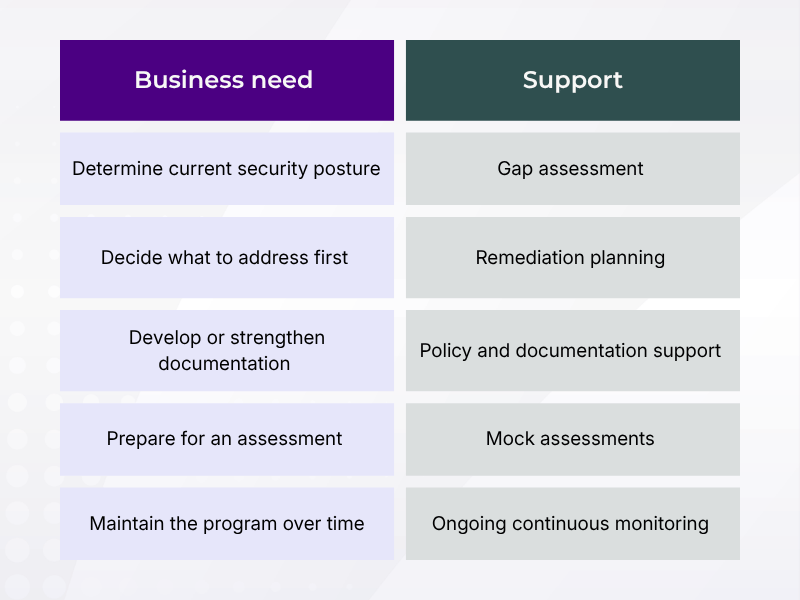
The goal should be to get the expertise needed to address the organization's specific requirements and resource constraints.
A small team can maintain compliance by combining internal ownership with targeted outside expertise and making compliance part of its ongoing security processes.
Compliance doesn't end when an assessment is complete. Policies need to be maintained, controls reviewed, evidence collected, and changes to systems or business operations evaluated.
For smaller teams, the challenge is maintaining those activities while continuing to run the business.
Periodic advisory support can help prevent compliance from becoming a last-minute project whenever an assessment or customer request arises. It also gives organizations a way to build ongoing compliance support into their security program without needing to maintain a full-time internal compliance team.
The most sustainable approach is usually one where internal teams retain ownership of their security program while outside advisors provide guidance, specialized expertise, and additional capacity when needed.
Cybersecurity compliance consulting is worth considering when the time, expertise, or risk involved in handling compliance internally outweighs the cost of specialized support.
Compliance consulting often delivers the most value when an organization:
Is pursuing compliance for the first time
Has a customer or contract requiring a specific framework
Is pursuing a government opportunity with security requirements
Doesn't know where to begin
Has identified gaps but doesn't know how to prioritize them
Has an assessment approaching
Has a small IT or security team managing compliance alongside other responsibilities
For a growing business, compliance often requires an investment of time, resources, and budget. The more important consideration is how to make that investment in a way that supports both compliance objectives and broader business goals.
RAMPQuest helps organizations navigate the compliance journey from understanding requirements and assessing their current security program to prioritizing gaps, preparing for assessments, and maintaining compliance.
For businesses with small security teams, RAMPQuest provides specialized compliance and security program expertise without requiring them to build an entire compliance function in-house.
If you're starting from scratch, responding to a customer or contract requirement, preparing for an assessment, or looking for ongoing support, RAMPQuest can help you determine where to focus your time and resources and how to build a security program your team can realistically maintain.
