-1.svg)
How to Determine the Right CMMC Level for Your Defense Contract
If your organization works with the Department of War (DoW), understanding your cybersecurity...

Every day, new software vulnerabilities are discovered. Most never make headlines. But the ones that do can lead to lost time, revenue, and even damage customer trust.
That’s why, for business leaders, cybersecurity incidents are rarely just technology problems.
They’re business problems.
A ransomware attack can completely stop operations. A data breach can impact customer relationships. A critical system outage can delay revenue-generating activities and strain internal resources.
This is where vulnerability management comes in.
Organizations that proactively manage vulnerabilities are often better positioned to reduce cyber risk, avoid costly disruptions, and make smarter decisions about where to invest their security resources.
Vulnerability management is a continuous strategy to discover, prioritize, and resolve security vulnerabilities within an organization’s IT infrastructure.
Think of it as preventative maintenance for your business.
Just as organizations routinely inspect equipment to avoid operational failures, vulnerability management helps identify technology weaknesses before they become costly incidents.
The goal isn't to fix every vulnerability immediately, but to understand which vulnerabilities present the greatest risk to the business and address those first.
The terms vulnerability, threat, and risk are often used interchangeably, but they have very different meanings.
A vulnerability is a weakness in a system, application, or process. This could be an unpatched server, a misconfigured application, or outdated software.
A threat is something that can exploit that weakness. Threats can include cybercriminals, ransomware groups, malicious insiders, or automated attacks scanning the internet for exposed systems.
Risk is the potential business impact if that threat successfully exploits the vulnerability.
Think of it this way: a vulnerability is an unlocked door. A threat is the person trying to get inside. Risk is what could happen to your business if they succeed.
This distinction matters because executives are not responsible for fixing every technical issue. They're responsible for understanding which risks could significantly impact the organization and ensuring resources are directed appropriately. 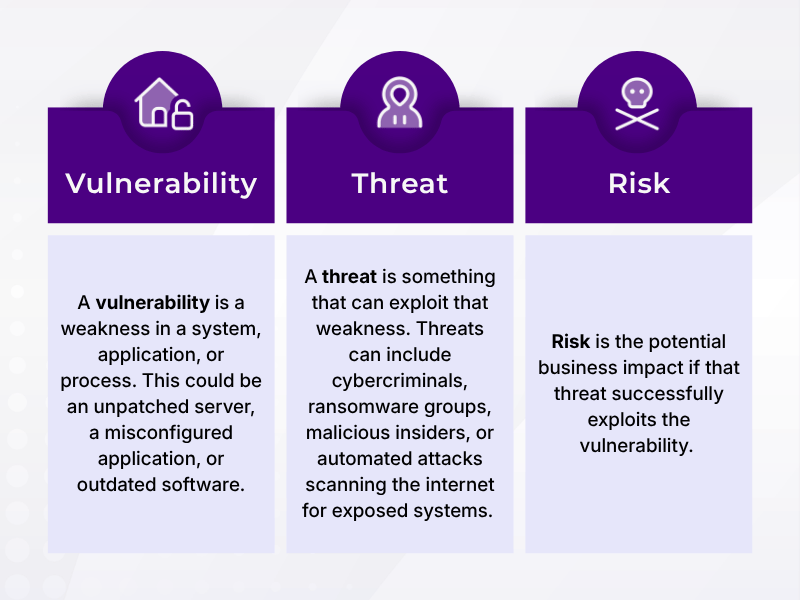
Many organizations don't experience the consequences of poor vulnerability management until an incident occurs.
A critical system suddenly becomes unavailable. Customer information is exposed. Operations are interrupted. The organization is forced into an expensive and time-consuming recovery plan that could have been prevented.
When vulnerabilities go unmanaged, the business impact can be significant.
Revenue can be affected when employees are unable to work, or customer services become unavailable. Growth initiatives can be delayed while teams shift their attention to incident response and remediation efforts. Existing customer relationships can suffer when trust is damaged, and prospective customers may think twice about doing business with an organization that has experienced a security incident.
There are financial implications as well. Incident response costs, legal expenses, recovery efforts, and regulatory consequences can quickly add up.
What begins as a technical issue can become a costly business disruption.
The question for business leaders isn't whether vulnerabilities exist. They do. The question is whether your organization has a repeatable process for identifying, prioritizing, and addressing them before they become business problems.
That’s where the vulnerability management cycle comes in.
The vulnerability management lifecycle provides organizations with a structured, repeatable approach to understanding and reducing cyber risk. Rather than reacting to incidents after they occur, it helps organizations proactively identify vulnerabilities, prioritize what matters most, and take action before weaknesses become costly disruptions.
The first step is understanding what exists within your environment and identifying where vulnerabilities may be present.
Organizations begin by auditing their assets, identifying software and systems in use, and assessing them for vulnerabilities. This provides visibility into potential weaknesses and helps leaders understand where risk may be accumulating across the business.
For executives, this phase is about gaining clarity. Without visibility into your technology environment, it's nearly impossible to make informed decisions about risk, resource allocation, or future investments.
Not every vulnerability presents the same level of risk.
Some vulnerabilities may affect non-critical systems and create little threat to business operations, while others could impact revenue-generating systems, expose sensitive information, or disrupt essential services.
Effective vulnerability management focuses on answering a critical question:
Which issues could have the greatest impact on the business if left unresolved?
By prioritizing vulnerabilities based on business impact, organizations can focus their time, budget, and resources where they matter most instead of attempting to address every issue equally.
Once vulnerabilities have been prioritized, organizations determine the most appropriate course of action. Resolution generally falls into one of three categories:
Remediation involves fully correcting the issue, such as applying a patch, updating software, or implementing a permanent fix.
Mitigation reduces the likelihood or impact of exploitation when immediate remediation isn't possible. This may include implementing compensating controls or limiting access to vulnerable systems.
Acceptance occurs when the organization determines that the risk is low enough to tolerate or when the cost of remediation outweighs the potential impact.
The right approach depends on the organization's risk tolerance, available resources, and business priorities.
The goal of vulnerability management is not to eliminate every vulnerability. It's to make informed, defensible decisions about risk and reduce the likelihood that a vulnerability becomes a costly business disruption.
Every organization has vulnerabilities. The difference is whether they're identified and addressed before they lead to disruption.
Vulnerability management isn't about chasing every security issue or trying to eliminate risk entirely. It's about understanding where your greatest exposures exist and taking practical steps to reduce them before they impact the business.
At RAMPQuest, we help organizations build sustainable approaches to vulnerability management that align security priorities with business objectives. By improving visibility, prioritizing risks, and creating a clear path forward, organizations can reduce uncertainty and build greater confidence in their cybersecurity programs and business goals.
Because protecting your technology is important, but protecting your business is essential.
